CICOPA President Iñigo Albizuri joins discussions at the Second World Summit for Social Development
December 2025
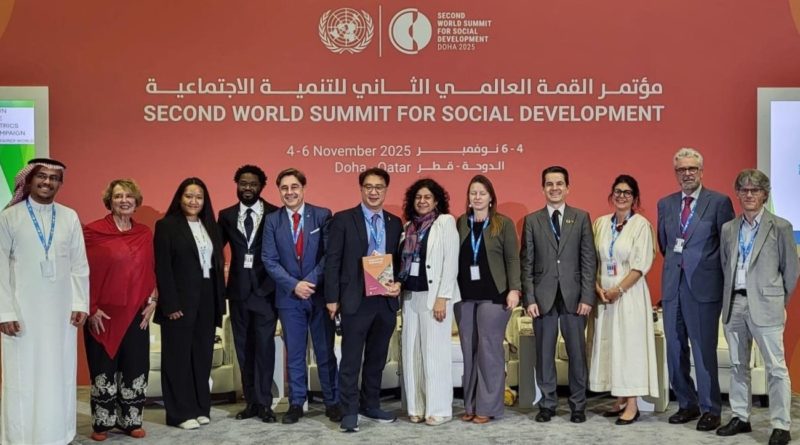
From 4 to 6 November 2025, the Second World Summit for Social Development (WSSD2) took place in Doha, Qatar, organised by UNDESA and the Government of Qatar. The event served as an opportunity to renew global commitments to social progress, strengthen international cooperation on social inclusion, and highlight the central role of local actors in driving social development.
The 2025 World Social Summit for Social Development is of great importance, since the first World Social Summit took place in 1995. The event was an occasion for governments, civil society organizations, private sector actors, and other stakeholders to collaborate on creating policies and strategies that promote inclusivity, equity, and sustainability.
The Summit builds on the legacy of the 1995 Copenhagen Declaration on social development and Programme of Action, reaffirming global commitments to people-centered, inclusive, and equitable development.
In addition, the event marked the official closing of the 2025 International Year of Cooperatives co-hosted by The International Cooperative Alliance (ICA) and The UN Committee for the Promotion and Advancement of Cooperatives (COPAC). The ICA presence at the Summit was essential as they also led the launch of the Cooperatives and Mutuals Leadership Circle (CM50), a dedicated effort to expand the cooperative and mutuals market share as part of the UN 2030 Agenda for Sustainable Development and beyond.
CICOPA President, Iñigo Albizuri Landazabal, participated in two sessions at the Summit as President of CICOPA, Board member of ICA and Head of global public affairs of Mondragon Corporation.
The first session he joined was a UN Local2030 Coalition Side Event “Scaling up local action for inclusive social development”. The session showcased innovative, local and community-led solutions advanced by local actors in the context of social development.
In his intervention, Mr. Albizuri stressed the ways cooperative and social economy models can drive scalable local economic development, while ensuring decent work and advancing social inclusion. He underlined that the cooperative model is an important tool to achieve the social goals in the 2023 agenda.
“If we have the workers ownership, we have people/citizenship involvement, and then the SDG and the 2030 agenda will be closer.”
He also mentioned several examples of cooperatives which, at the local level, put into practice projects on education and social development.
“Worker cooperatives are schools of democracy, which have social transformation as a final goal.”
CICOPA President, Iñigo Albizuri Landazabal, also joined the session “Innovative sustainability assessment for social inclusion, decent work and poverty eradication”.
The session presented a range of innovative methodologies and transformative indicators that go beyond conventional environmental, social, and corporate governance (ESG) and reporting frameworks. These alternative approaches aim to assess sustainability performance based not merely on incremental improvement, but on whether activities are aligned with scientifically and socially defined thresholds, such as planetary boundaries, living wages, and gender equality. An example of these alternative approaches is the Sustainable Development Performance Indicators (SDPI), developed by UNRISD, which offers a context-based, normative framework for assessing real sustainability performance and fostering transparent, threshold-aligned evaluation.
During the session, it was showcased how these methodologies can empower economic actors, strengthen institutional accountability, inform policy, and unlock access to mission-aligned finance.
CICOPA is glad to have had the chance to join the discussions and contribute to the sessions on local actions and innovative sustainability assessment, bringing the cooperative model as a key tool to build new strategies for social progress, poverty eradication, decent work, and social inclusion.